
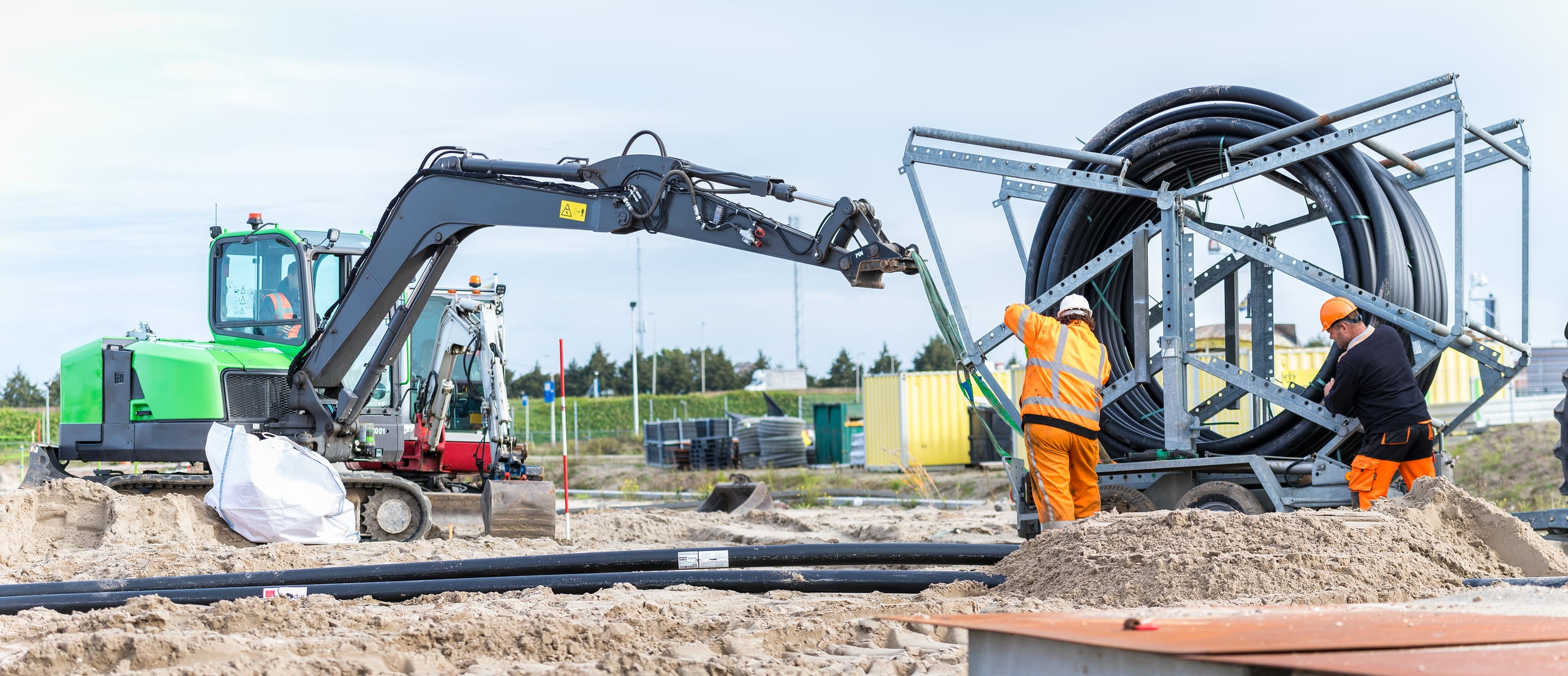
The Netherlands is progressing towards zero emission construction equipment. This is crucial for climate, natural spaces, and improving the health of our inhabitants and construction workers. The Dutch Program for Zero Emission Construction Equipment (in Dutch: Schoon en Emissieloos Bouwen “SEB”) brings together governments, industry stakeholders, and knowledge institutions to collaborate on enhancing the sustainability of construction equipment.
What is SEB?
The entire construction sector is facing the shared challenge of making construction more sustainable. Through the Clean and Emission-Free Construction (SEB) programme, we are working together on a single, coordinated approach to carrying out construction, maintenance and demolition projects in a cleaner way.
The program includes the Roadmap for Zero Emission Construction Equipment (Roadmap ZECE), established in 2023. This Roadmap ZECE outlines how targets for nitrogen, CO2, and particulate matter can be met. With a view to providing clarity to market parties and public authorities, the roadmap presents a multiannual approach for incrementally reducing construction industry emissions in the years to 2030. It specifies and describes measures that can be taken to achieve emissions reduction in effective, feasible and affordable ways.
The SEB programme
The Dutch government has set targets and ambitions for reducing nitrogen emissions, CO₂ emissions and particulate matter. These ambitions also apply to construction equipment and are laid down in the Nitrogen Reduction and Nature Improvement Programme (PSN), the Climate Agreement, the Climate-Neutral and Circular Infrastructure Strategy, and the Clean Air Agreement.
The SEB programme provides direction and practical support through a range of instruments to help achieve these goals on time. SEB focuses on the following types of construction equipment: mobile machinery, vehicles and vessels.
Requirements
The core of the measures involves applying emission requirements to construction equipment used in construction, maintenance, and demolition projects. These requirements are enforced through tendering processes and the granting of permits for projects and are differentiated per power range, and types of construction equipment (machinery, road vehicles, floating equipment). By 2028, a significant portion of mobile machinery and road vehicles will be required to be zero-emission, and in 2035 nearly all deployed construction equipment will be zero-emission.
Clean and Emission-Free Construction (SEB) contributes to:
- Nature restoration (NOx). Supporting the Nitrogen Reduction and Nature Improvement Programme.
Targets and ambitions for 2030:
- 60% reduction in NOx emissions from construction activities compared with 2018.
- Fulfilling the statutory emissions reduction obligation.
2. Climate (CO₂-equivalent). Supporting the Climate Agreement.
Targets and ambitions for 2030:
- A reduction of 0.4 million tonnes of CO₂ emissions compared with 2019.
- Contributing to Climate-Neutral and Circular Infrastructure Projects (KCI Strategy), including targets for mobile construction equipment (with further expansion for mobility and inland shipping).
3. Health (PM10 and NO₂). Supporting the Clean Air Agreement.
Targets and ambitions for 2030:
- 75% reduction in health impacts compared with 2016.
- Phasing out machinery with high nitrogen emissions and without particulate filters as quickly as possible.
Benefits of SEB
1. SEB Roadmap and Convenant
- The SEB Roadmap sets out clear milestones and practical actions to reduce emissions step by step through to 2030 and beyond.
- The SEB Covenant sets out agreements between participating organisations on the joint implementation of the SEB Roadmap.
2. Practical support
Support Team and KOP Programme
Practical support is available for public authorities that sign the SEB Covenant. This includes:
- support with procurement and tendering;
- energy scans for projects to assess charging opportunities;
- regional charging maps and construction logistics workshops;
- support for applying SEB in rural areas;
- examples of administrative decision documents;
- guidance on informing and engaging your organisation;
- research into the additional costs of SEB and monitoring compliance in practice.
Market parties can receive support through the Knowledge, Scaling-up and Practical Experience Programme (KOP).
3. Financial support
- Municipalities, provinces and water authorities can apply for financial compensation through the SPUK SEB scheme to cover the additional costs of procuring zero-emission construction equipment. More information is available through the Clean and Emission-Free Construction Incentive Scheme for Local and Regional Authorities (SPUK SEB).
- Companies can apply for funding through the Clean and Emission-Free Construction Equipment Subsidy Scheme (SSEB).
Funding is available for:- purchasing zero-emission construction equipment (SSEB Purchase);
- converting existing construction machinery and construction vessels to low-emission or zero-emission operation (SSEB Retrofit);
- experimental development projects aimed at innovating zero-emission construction equipment and charging infrastructure (SSEB Innovation – Experimental Development);
- feasibility studies leading to experimental development projects for innovations in zero-emission construction equipment and the associated charging infrastructure (SSEB Innovation – Feasibility Study).
More information and guidance on applying for this scheme can be found on the website of the Netherlands Enterprise Agency (RVO).
Who is involved in SEB?
The SEB programme brings together the Dutch national government, regional and local authorities, market parties, industry associations and knowledge institutions to achieve shared goals for nature, climate and public health.
Zero-emission construction in practice
The Netherlands is making great strides in zero-emission construction. To showcase these efforts, we’ve created a series of videos (including English subtitles) that highlight inspiring examples of zero-emission construction in action, at 5 different locations.
In Harderwijk, the process of preparing 'Waterfront fase 3' is happening completely emission-free. When the municipality of Harderwijk send out a request for a sustainable tender, Boskalis took the chance to work on emission-free execution of the project. The municipality offers their own charging facilities. Watch the video on this page.
The dikes between Tiel and Waardenburg are being reinforced. The program for protection against high water (HWBP) wants to execute this project emission-free. The consortium Mekante Diek promised to only use electrical equipment. Watch the video on this page.
In Lochem, the N346 Schakel Achterhoek-A1 project features the deployment of the very first electrically powered asphalt press, paving the way for a more sustainable future. Watch the video on this page.
The main square in Groningen is being redeveloped largely emission-free. Watch the video on this page.
In Arnhem, a new cycling path is being built using emission-free equipment and a unique charging station. Watch the video on this page.
More information
Below you can find more information (in English) on the program:
- Summary of the Roadmap Zero Emission Construction Equipment
- Voluntary Agreement on Clean and Zero-Emission Construction, including emission requirements in Annexe 1.
- Conclusions research on pilot projects that took place in 2021 - 2023
For more information or to get in touch, please contact us.